
Summary: For balance and gait disorders in Hingham, Elliott Physical Therapy and Bay State Physical Therapy explicitly list balance and gait care. Hingham Physical Therapy lists balance services, South Shore Health names vestibular balance disorders, and Hartman Physical Therapy lists gait analysis and balance testing among common evaluation components. Compare the published scope, then confirm the appropriate appointment and current location. These listings describe services, not a diagnosis or a ranking of clinical outcomes.
Comparing balance and gait therapy in Hingham
Hingham-area balance and gait options differ in their published services: the profiles below compare balance care, vestibular services, movement assessment and pediatric therapy. The order is a reading aid, not a measured ranking of treatment quality. Use the service descriptions and suggested questions to compare the options without assuming that every practice offers the same assessment.
A broad clinic directory is a starting point, not evidence that every listed practice evaluates walking or balance concerns. When a shaky step, slower stair climbing, or a recent stumble makes ordinary errands more difficult, the useful comparison is the service each local practice actually publishes.
Compare the individual practice page rather than treating a directory category as confirmation of a service. A listing under healthcare does not, by itself, answer who evaluates balance concerns, which age groups are seen, or whether a specific clinician is available.
For a search about balance and gait disorders in Hingham, look for explicit service wording rather than relying on a familiar practice name. Balance care, gait assessment, vestibular services and pediatric motor support are useful terms to check on the linked pages. Guardian Family Dental is a dental practice, not a Hingham balance-care option; its link should not be read as a recommendation for walking or balance assessment. The relevant comparison here is among the rehabilitation and pediatric providers described below.
The options below are not interchangeable. A published vestibular service, an evaluation that may include gait testing, and pediatric occupational therapy describe different offerings. Check both the type of service and the age group before comparing travel arrangements. The descriptions do not establish which provider can assess the cause of your symptoms or whether a particular therapy is suitable for you.
1. Elliott Physical Therapy: balance and gait care
The Elliott Physical Therapy Hingham clinic lists balance and gait disorders, including fall prevention, among the conditions treated at that location. That explicit wording is useful when comparing local service descriptions. It does not establish the cause of an individual's unsteadiness, confirm direct-access or insurance requirements, or show what every initial visit will include. Those details need confirmation for the appointment being considered.
For Elliott Physical Therapy, keep the distinction between the published condition list and the assessment you are requesting. Ask whether the proposed evaluation includes watching you walk, balance testing or a discussion of mobility at home. These are questions to ask, not confirmed features of every Elliott appointment.
If you already have an assessment or referral, use its wording rather than assigning yourself a diagnosis. Ask which clinician would evaluate the concern and what information to bring. Confirm any referral, coverage or scheduling requirements for your circumstances instead of inferring them from the availability of an online appointment request.
Before calling, write down the exact movement that causes trouble and the wording the practice uses. For example, describe wobbling while turning in a hallway without labelling it a mechanical or inner-ear problem. Ask whether the clinic evaluates that concern and whether another assessment is needed before therapy. This keeps the conversation about your actual experience rather than a diagnosis inferred from a directory profile.
2. Bay State Physical Therapy: listed balance and gait specialty
At 170 Shipyard Drive, Bay State Physical Therapy Hingham lists balance and gait disorders under its clinical specialties, which gives people a clear sign before they book. That matters for anyone who wants to see an explicit specialty on an official practice page before making contact.
For someone comparing general orthopedic care with vestibular rehabilitation physical therapy, Bay State's published balance and gait specialty is a starting point for questions, not confirmation of a particular vestibular program. Ask whether the Hingham location currently offers the specific assessment or therapy named in an existing referral. Avoid assuming that a broad specialty label establishes every clinician's training or availability.
When you speak with the intake desk at Bay State Physical Therapy, use the exact wording from a physician order or your own symptom log, such as post-dizziness equilibrium issues, repeated stumbling episodes, or a gait change after an injury. Ask the intake team what type of appointment is appropriate rather than assuming the symptom description automatically selects an assessment.
The published Hingham address is 170 Shipyard Drive. Confirm that this is the location of the appointment being offered. Ask whether your insurance plan requires a referral, what documents are needed and whether the requested service is available there. Record the answers as appointment-specific information, not a general rule about all physical therapy visits.
3. Hingham Physical Therapy: balance services on Lincoln Street
The Hingham Physical Therapy balance services page lists balance and concussion services as well as neurological care at 184 Lincoln Street. Its published scope does not support treating it as suitable only for uncomplicated unsteadiness or ruling it out for neurological concerns. Compare the stated services without drawing those boundaries yourself.
If everyday movement is difficult, describe the situation rather than deciding which diagnosis it represents. Examples to mention might include using a wall for support, relying on a handrail or feeling uncertain on an uneven path. Ask whether the clinic evaluates that concern and what the appointment would involve.
When you contact Hingham Physical Therapy for the first time, ask what paperwork you need before arrival, including physician referrals, medication lists, fall histories, or notes on when the instability gets worse. Bringing those items ahead of time turns a generic intake into a more focused balance visit.
The central address gives patients a clear point of reference if travel time matters. The Lincoln Street location can be compared with the other offices for practical travel needs. Location is a separate question from clinical suitability. Confirm that the service and clinician being offered match the reason for evaluation, rather than choosing on proximity or the absence of an existing diagnosis alone.
4. South Shore Health: vestibular balance disorders
South Shore Health physical therapy lists vestibular balance disorders, vertigo/dizziness and motion sensitivity among the conditions treated. People comparing vestibular balance rehabilitation therapy can use that published wording to ask about the appropriate clinician and location. It is not evidence that this provider is superior to the others or that dizziness has a particular cause.
South Shore Health also published a notice about its department's move to Hingham outpatient care center. Treat a relocation notice as background, not confirmation of a current appointment address. Ask which facility provides the requested service and whether the appointment offered is at that site; the notice alone does not establish a treatment advantage.
Prospective patients who reach out to South Shore Health should ask whether their intake visit will be handled by a clinician trained in vestibular rehabilitation therapy, especially if lightheadedness or spinning comes with movement. Describe those symptoms without assuming that they come from the inner ear. Ask what assessment is appropriate and whether the team needs information from an existing medical evaluation before the appointment.
When you schedule, say clearly whether spinning sensations or head-movement dizziness come with the balance problem rather than asking for a general walking-difficulty visit. Ask the intake team how it handles that concern rather than assuming a particular pathway. Confirm the active office address, the service available at that office and any preparation instructions before travelling. Keep those current appointment details separate from the historical relocation notice.
5. Hartman Physical Therapy: gait analysis and balance testing
The Hartman Physical Therapy Hingham services page names gait analysis and balance testing among common evaluation components, alongside strength and range-of-motion testing. That is useful published detail for comparing assessment approaches. It does not promise that every visitor receives every test or that the evaluation is limited to walking and balance. Ask which components would be considered for the concern you describe.
Hartman's service page does not establish a fixed first-visit protocol centred on stride timing. If your concern involves catching a foot, uneven steps or difficulty turning, describe the example and ask how the clinician would assess it. Keep the question open rather than assuming that a particular test or exercise plan is required.
For Hartman Physical Therapy, useful questions include:
- Which features of walking might the clinician observe or measure?
- Would balance testing be part of the proposed assessment?
- How would any findings inform goals and follow-up assessment?
Ask for an explanation in plain language. The service list alone cannot predict how quickly anyone will improve or which treatment will be appropriate.
A service label and an appointment description answer different questions: the former describes an offering, while the latter should clarify what is proposed for your visit. Call ahead and ask how the team runs its balance and gait screens. Ask how the clinician would explain any assessment results and whether you would receive a summary. You want a clear answer about what the visit covers before you commit to regular clinic slots.
6. South Shore Therapies: pediatric therapy and coordination questions
The South Shore Therapies Hingham contact page describes pediatric occupational and speech therapy; its occupational therapy description includes motor skills, coordination and balance. This is a pediatric service to compare, not evidence of an adult gait clinic or a confirmed pediatric physical therapy program. Ask which discipline and clinician would assess the concern.
A child's difficulty with climbing, coordinating movements or ordinary play is an example to describe, not enough information for this article to recommend a diagnosis or testing protocol. Ask about the age groups served, the scope of the proposed evaluation and whether another kind of assessment is needed. Do not assume that every pediatric therapy service uses the same assessment model.
Parents who call South Shore Therapies can help by describing home behavior in plain, concrete stories. Say that a child trips over flat floors, freezes on stairs, or falls behind during outdoor games. That gives the pediatric staff better clues than a vague note about clumsiness ever will.
Families get more from the process when they write down where balance problems show up, such as school gym class, stepping off curbs, or running around the park, and whether the main issue is staying upright, coordinating limbs, or both at once. You can check the local contact page to confirm the pediatric focus and verify that the therapists work regularly on the motor developmental needs your child shows every day.
How should you choose among Hingham balance and gait providers?
Compare the clinic's published services with the concern you want assessed, then verify the proposed appointment rather than diagnosing yourself from a symptom pattern. Describe dizziness, uneven steps, general unsteadiness or a child's coordination difficulties in your own words. These are reasons to ask questions about assessment, not a reliable way to assign yourself an inner-ear, mechanical or developmental diagnosis.
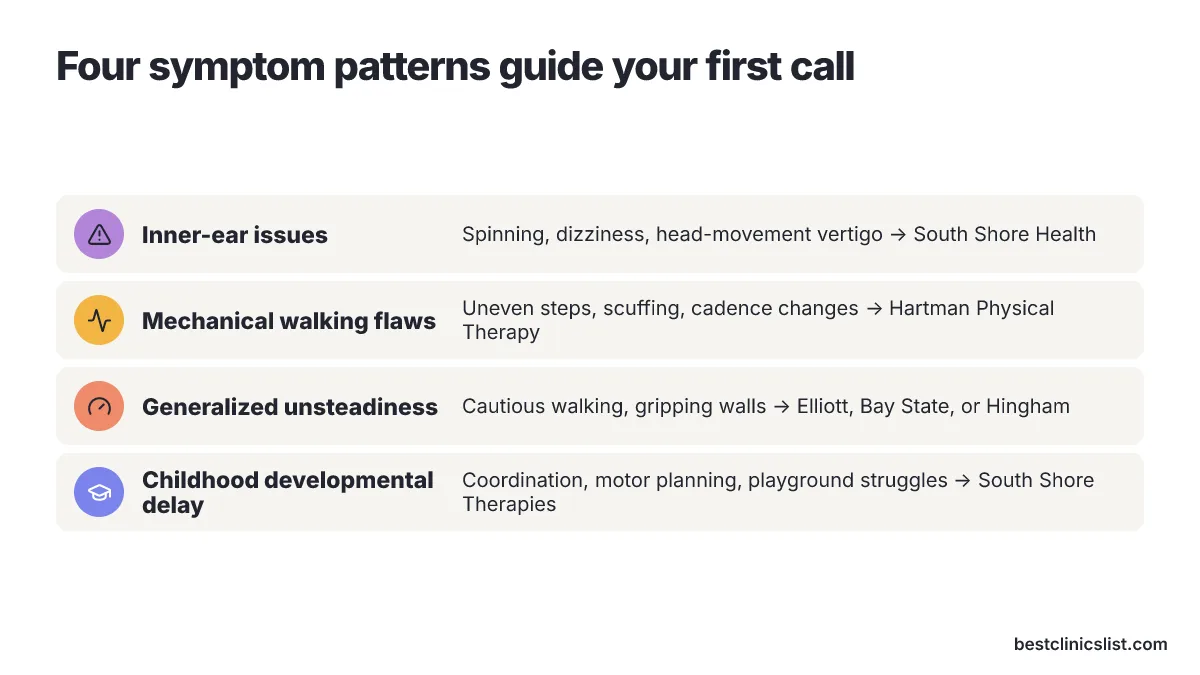
The Best Clinics List directory is a shortlist starting point, not independent evidence of treatment quality or a substitute for assessment. This comparison uses the linked practice descriptions to distinguish services; it does not report site visits, patient outcomes or a comparative clinical quality study. The diagram above is a discussion aid, not a diagnostic decision tree.
Use these published service distinctions to organize your questions:
- Vestibular service questions: South Shore Health explicitly lists vestibular balance disorders and vertigo/dizziness. Ask about the current service location and assessment process rather than treating the listing as a diagnosis.
- Walking-assessment questions: Hartman Physical Therapy lists gait analysis and balance testing as common evaluation components. Ask which components would be relevant to the concern being assessed.
- Balance-service comparisons: Elliott Physical Therapy and Bay State Physical Therapy list balance and gait disorders; Hingham Physical Therapy lists balance services. Confirm the clinician, scope and appointment requirements separately.
- Pediatric-service questions: South Shore Therapies describes pediatric occupational therapy that includes coordination and balance. Ask whether the proposed service matches the child's needs; do not assume it is interchangeable with adult physical therapy.
For a child, confirm the age range and therapy discipline explicitly. South Shore Therapies is included because its Hingham page describes pediatric services, not because this article has determined the cause of a child's difficulties. A pediatric occupational therapy listing does not establish that a particular medical evaluation is unnecessary or that the service replaces other rehabilitation options.
For intake terminology, ask what the clinic means by balance and vestibular physical therapy rather than using that phrase as a self-diagnosis. If an existing referral names gait analysis or balance therapy, quote it accurately. Otherwise, describe what happens during movement and ask how the concern would be evaluated; a technical label is not required to explain your experience.
Travel logistics belong alongside, not ahead of, service fit. Compare the Lincoln Street and Shipyard Drive locations with the actual South Shore Health facility offered for your appointment. Ask about access to the building, transport arrangements and any assistance you may need on arrival. A relocation announcement or a general service page does not confirm that every service is offered at every facility.
Do not use this shortlist to decide that symptoms are mild enough for a general appointment or that advanced testing is required. Neither conclusion follows from a directory description. If you already have a referral, ask whether the proposed visit fulfils it. If the reason for the balance change remains unclear, explain that uncertainty when asking about assessment rather than assuming a therapy category answers the medical question.
A concrete description can frame the intake questions when symptoms are difficult to articulate. For example, describe losing balance when turning, dizziness when stepping off a curb, catching a foot on carpet edges or a child's difficulty joining active games. Then ask whether the proposed appointment addresses that concern; describing it does not select a diagnosis or a therapy pathway.
Before finalizing an appointment, distinguish what is published from what has been confirmed for you. A named condition or test is evidence of a stated service, not a guarantee of acceptance, availability, coverage or outcome. If a practice's description does not clearly address your question, ask for clarification rather than treating another provider in this list as an automatic fallback. Record the service, location and next administrative step confirmed by the office.
When balance changes need urgent care
Sudden trouble walking, dizziness, loss of balance or lack of coordination can be signs of stroke, according to the CDC's stroke warning signs. Seek emergency help immediately rather than waiting for a routine therapy appointment if these symptoms start suddenly. This directory comparison cannot assess the cause of a new balance problem.
Choosing a provider from the published services
Choose a shortlist by the published service, then confirm the appointment details without assuming that the listing identifies your diagnosis. Describe the main difficulty plainly: dizziness during movement, uneven steps, unsteadiness or a child's coordination concern. Ask what type of assessment is offered, who would conduct it and whether the office needs an existing referral or evaluation to decide on the appropriate visit.
Arrive at the first visit prepared with documentation. Gather any physician orders, write down a record of when instability occurs, and note a specific scenario where balance fails, such as turning around in a narrow hallway or stepping across grass.
Do not treat a promise of testing as proof that the search is complete. Check the proposed service, the clinician and location, and the requirements that apply to your appointment. This comparison can organize those questions, but it cannot determine which assessment or treatment is right for you.
Frequently Asked Questions
Which clinics in Hingham treat balance and gait disorders?
Elliott Physical Therapy and Bay State Physical Therapy explicitly list balance and gait care. Hingham Physical Therapy lists balance services, while South Shore Health names vestibular balance disorders. Hartman Physical Therapy names gait analysis and balance testing among common evaluation components. Confirm the scope of the actual appointment rather than assuming all services or tests apply to everyone.
Where is Bay State Physical Therapy in Hingham?
Bay State Physical Therapy lists its Hingham location at 170 Shipyard Drive, and the page explicitly includes balance and gait disorders among its specialties. The article advises callers to confirm the address with the receptionist rather than assume they are booking at a particular regional office. Ask the intake desk whether your insurance plan requires a formal physician referral before the first evaluation.
Which Hingham clinic treats balance problems related to dizziness or vertigo?
South Shore Health lists vestibular balance disorders and vertigo/dizziness among the conditions treated. That makes it relevant to ask about vestibular assessment, but does not establish the cause of symptoms or make it a superior choice for every patient. When booking, explain whether spinning sensations or dizziness with head movement are part of the problem, and ask whether the intake visit will be handled by a clinician trained in vestibular rehabilitation. Confirm the active office address before traveling.
What should I ask before booking balance and gait therapy in Hingham?
Describe the specific movement that causes trouble and ask whether the clinic’s current services fit that concern. Depending on the clinic, the article suggests asking about gait observation and balance testing, required paperwork, physician referrals, and location. If you have a physician order or symptom log, use its wording when speaking with intake so the request is routed appropriately.